
INDUSTRY / ORBITAL COMPUTING / REGIONAL OPPORTUNITY
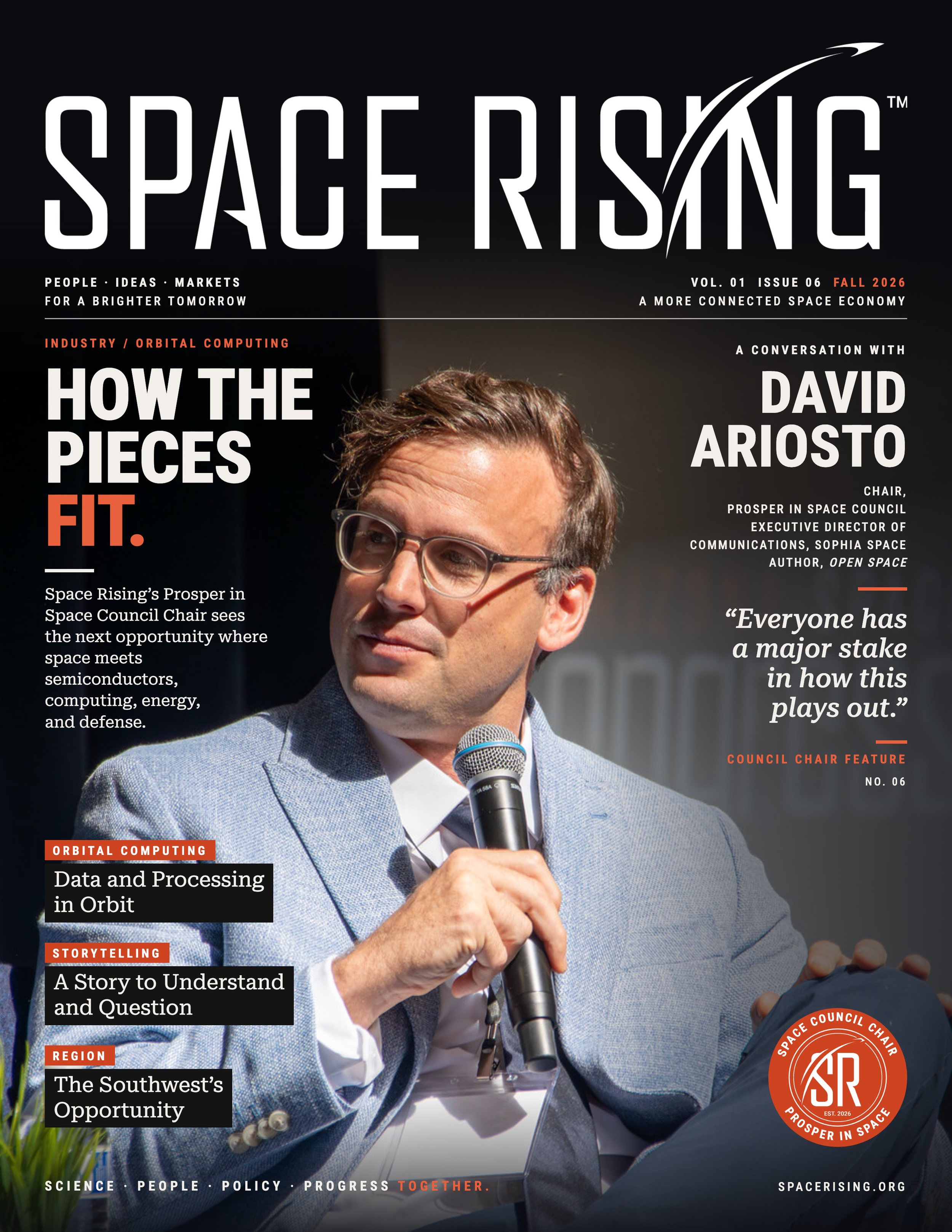
Space Rising’s Prosper in Space Council Chair sees the next opportunity where space meets semiconductors, computing, energy, and defense. His work begins with helping those industries understand what they could build together.
By Angelica Sirotin | Oct 30, 2026 | Space Rising
David Ariosto entered the space industry with a journalist’s question: how do the pieces fit together?
Around six years ago, he was following headlines about SpaceX, Blue Origin, China, and NASA. Each was compelling on its own. He wanted to understand the commercial ambitions, geopolitical interests, and emerging technologies connecting them.
“They seemed like disparate parts of a similar story.”
That inquiry became Open Space, published in March 2026. It also brought him into conversations with people building the industry. As he learned more, he began to see opportunities for their expertise, resources, and talent to work together.
Today, Ariosto brings that perspective to Space Rising’s Prosper in Space Council and his work as Executive Director of Communications, Sophia Space. For him, the question has become increasingly practical: how can promising technologies become infrastructure that supports new businesses?
His interest also has a personal history. His mother grew up watching the Apollo era and wanted to become an astronaut. Years later, he shared his own curiosity with his daughter through camping trips, amateur astronomy, and stories about the night sky.
A 2014 filmmaking trip to Svalbard made that curiosity especially vivid. Watching the Northern Lights in the Arctic prompted questions about humanity’s place in the universe and the technologies and stories that might carry people farther.
“It just struck me as such an otherworldly phenomenon,” he recalls.
Making the space economy matter to more people
Reporting offered Ariosto a way to follow those questions across borders and institutions. Working on his book gave him access to commercial and government space organizations, as well as a closer view of how disconnected their efforts could be.
He wanted to help different stakeholders make better use of one another’s capabilities. That instinct now sits alongside a concern about how the public understands the industry.
Ariosto remembers the Apollo story as one of shared human achievement. He wonders whether today’s competition among companies and governments can obscure that sense of collective curiosity. In his view, the perception of space as a domain for billionaires risks distancing people from decisions that will affect their lives.
“Everyone has a major stake in how this plays out.”
He points to the technologies being adopted, the rules being developed, and the growing relationship between space infrastructure and an economy increasingly shaped by AI. Participation matters because people who remain engaged will help determine how that future works.
“If you’re not, what’s going to happen is those who are will set the terms,” he says.
A story people can understand and question
Reaching people is harder in a fragmented media environment. Ariosto contrasts the small number of dominant broadcasters and newspapers of an earlier era with the many channels through which people now encounter information.
That fragmentation also creates more ways to reach an audience. He sees a role for storytelling that makes unfamiliar technologies understandable and connects orbital activity to life on Earth.
He is equally clear about the need for critical judgment. A compelling account of an orbital economy should help people examine what is being built, who benefits, and how progress will be assessed. Understanding the possibilities and questioning the terms can happen together.
The computing infrastructure an orbital economy needs
At Sophia Space, Ariosto works with a company developing modular computing platforms for orbit. Its TILE architecture brings computing, power, and passive thermal management together, building on research originating at NASA’s Jet Propulsion Laboratory and Caltech.
The engineering challenge is fundamental. Computing generates heat, and in the vacuum of space there is no surrounding air to carry it away. Sophia’s approach uses radiation to reject heat and a modular design intended to support growth without reworking the cooling architecture for every larger system.
For Ariosto, the importance of that work extends well beyond the processor.
“You don’t really develop an orbital economy without data and processing.”
Satellites can collect more information than constrained communications links and ground systems can readily handle. Processing data closer to where it is generated could help operators make better use of that information and reduce the amount that needs to be sent to Earth.
Ariosto points to potential applications in Earth observation, national security, and more autonomous orbital operations. He also sees consequences for how people understand natural disasters, wildfires, climate change, and supply chains.
Sophia is developing the underlying technology for those uses. Ariosto sees the broader opportunity in the services that better access to data and processing could support.
Building capability with responsibility
Ariosto places responsibility alongside technical progress. More information brings questions about how it is handled, how it is used, and the regulatory structures that develop around it.
“Hopefully, we’ll be one of those responsible stewards at the table that can develop this technology responsibly,” he says.
The same ability to connect ideas that drew him into reporting now helps him explain why a component of space infrastructure matters to people working far beyond the space sector.
The Southwest’s opportunity is already taking shape
Asked what he wants to see through Space Rising, Ariosto turns to the industries already established across the Southwest: semiconductors, AI, advanced computing, energy, and defense.
Attracting space companies is part of the opportunity. He also sees potential in connecting those existing industries with universities, investors, and government institutions to create new markets and businesses.
“Space is becoming increasingly integrated with industries that already have a significant footprint here,” he says.
That makes access to capital and workforce development central questions. A promising technology needs people who can develop it, institutions that can support it, and a route toward commercially viable infrastructure.
Where the council conversation can begin
His perspective suggests three useful questions for Arizona’s space economy. Which capabilities in established industries could address a specific space-sector need? Where do talent or capital gaps prevent a technology from advancing? And who needs to participate for an emerging application to become a viable business?
These are starting points for discussion, grounded in the connections Ariosto described. The value comes from bringing people into the conversation who may already have part of the answer, even if they do not think of themselves as working in space.
His own path shows how that can happen. A journalist trying to understand a global story became a participant in the industry he was examining. For Arizona and the wider Southwest, he sees room for many more disciplines to make that transition.
The next chapter of the space economy will depend on who recognizes that they have something to contribute, and how effectively those contributions come together.
Have a story the space community should hear?
We’d love to hear what you’re working on. Talk to us about a sponsored feature in Space Rising, with an interview-led article and a custom magazine cover your team can share.
Get in touch: angelica@spacerising.org
This interview was conducted by Space Rising. Quotes have been lightly edited for length and clarity.
